UNITED KINGDOM
 Australia
 World
World


Whats The Difference Between Effect And Affect
Effect and affect are often confused due to their similar pronunciation, but they have distinct meanings in grammar and usage. Effect is a noun referring to the result or consequence of an action. For example, "The new policy had a positive effect on employee morale." Affect, on the other hand, is usually used as a verb indicating influence or impact. For instance, "The music affected her mood positively." To remember the difference, consider that affect starts with "a" like action, while effect starts with "e" like end result. When writing, it's crucial to use the correct one to convey your intended meaning accurately. Utilizing a spell check online tool can help you spot any inadvertent errors in your usage of effect and affect, ensuring your writing maintains clarity and precision.
What Defines The Disparity Between "Effect" And "Affect" In Language?
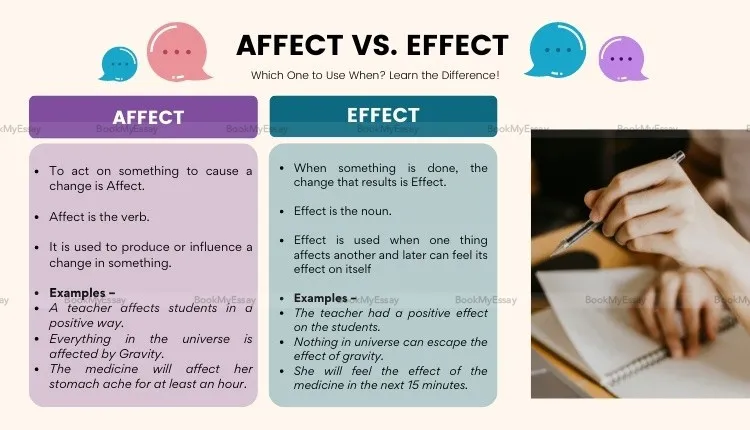
The difference between affect and effect lies in their grammatical roles and meanings within a sentence. "Affect" is primarily a verb, indicating influence or change. It refers to the action of impacting something or someone. On the other hand, "effect" commonly functions as a noun, denoting the result or outcome of an action or event. It signifies what happens as a consequence of something else. However, "effect" can also be used as a verb, but this usage is less frequent and typically means to bring about or accomplish something. Understanding this disparity is crucial in effective communication, as misuse can lead to confusion. Remembering that "affect" is typically a verb and "effect" is mainly a noun helps to clarify their usage. Mastering these nuances enhances language precision and fosters clearer expression in writing and speech.
How Do We Discern "Effect" From "Affect" In Communication?
Understanding the distinction between "effect" and "affect" is crucial in effective communication. "Effect" is typically a noun referring to the result or outcome of something, while "affect" is usually a verb indicating influence or change. In communication, clarity can be achieved by using "effect" when discussing outcomes or consequences and "affect" when describing how something impacts or influences. For instance, in an academic paper, one might write, "The effect of climate change on biodiversity is significant," indicating the outcome of climate change. Conversely, "Climate change affects biodiversity," emphasizes the influence or impact of climate change on biodiversity. Utilizing these terms appropriately enhances the precision and coherence of written and verbal communication. For further guidance on linguistic nuances and effective writing, seeking assistance from professionals at "All Assignment Help" can be invaluable. Their expertise ensures clarity and accuracy in conveying ideas, facilitating effective communication.
Can You Elucidate The Nuances Between "Effect" And "Affect"?
Tips for getting English language learners past typical obstacles include distinguishing between "effect" and "affect" in communication. "Effect" is a noun, referring to the result or outcome of an action. For example, "The new policy had a positive effect on employee morale." On the other hand, "affect" is typically used as a verb, meaning to influence or produce a change. For instance, "The rainy weather affected the turnout at the event." An easy way to remember the difference is that "effect" often follows words like "the," "an," or "any," while "affect" is typically followed by an object or subject that is being influenced. By practicing with examples and understanding the context in which each word is used, English language learners can discern between "effect" and "affect" effectively, enhancing their communication skills.
What Distinguishes The Usage Of "Effect" From That Of "Affect"?
In the realm of academic writing service, precision in language is paramount, and understanding the distinction between "effect" and "affect" is crucial. "Effect" is commonly used as a noun, referring to the result or outcome of an action or event. In academic writing, it is employed to describe the consequence of a particular phenomenon or research findings. On the other hand, "affect" is predominantly a verb denoting influence or change. It pertains to the action of causing an effect or bringing about a change. In academic discourse, "affect" is often utilized to discuss how one variable impacts another in research or scholarly analysis. Confusing these terms can undermine the clarity and credibility of academic work, highlighting the importance of mastering their correct usage to convey ideas accurately and professionally.
Can "BookMyEssay" Elucidate The Disparity Between Effect And Affect?
BookMyEssay can indeed elucidate the disparity between "effect" and "affect" comprehensively. Effect refers to the result or outcome of an action or event, whereas affect pertains to the influence or impact something has on someone or something else. The difference lies in their usage and grammatical roles within sentences. Effect is typically used as a noun, denoting the result produced by an action or a cause, while affect is often used as a verb, indicating the action of influencing or causing change. However, affect can also be used as a noun in psychology to describe emotion or mood. BookMyEssay elucidation would likely include examples and clarification of contexts in which each term is appropriately used, aiding learners in grasping the nuances between the two and enhancing their proficiency in English language usage.
Popular Subject
- Cheap Homework Help
- Do My Essay Online
- London Assignment Writing Help
- Write My Assignment for Me
- A+ Certified Professional Assign...
- Yahoo! Query Language Assignment...
- Competition and Consumer Law Ass...
- Law Dissertation Assignment Help
- History Homework Writing Help
- Bamboo Flooring Assignment Help
- AP Style Writing Assignment Help
- Business Cycle Assignment Help
Rating

Charles
Australia
Rating:
Everything is good and helpdesk supports is cooperative, all problems of my assignment are solved perfectly.

Johnson
USA
Rating:
Thank you BookMyEssay for all your great services. I am so happy that I get this assistance with my study.

 3 Bellbridge Dr, Hoppers Crossing, Melbourne VIC 3029