UNITED KINGDOM
 Australia
 World
World


How To Calculate Average Acceleration
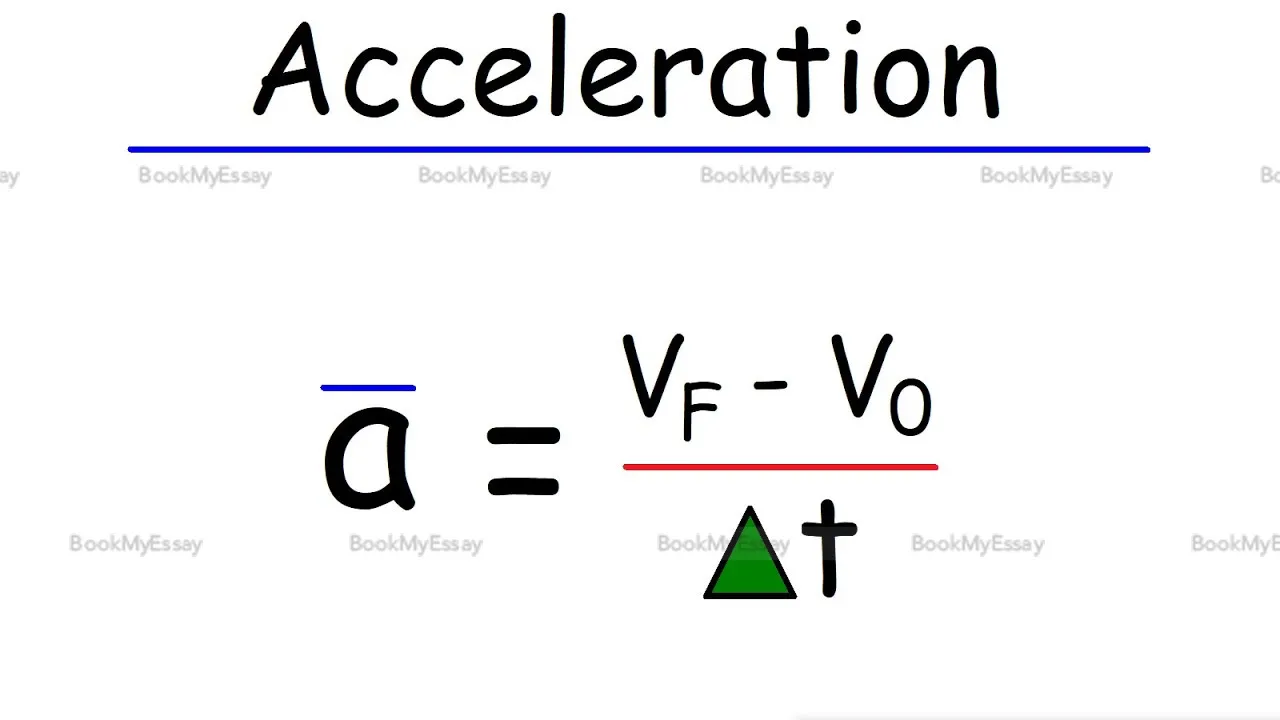
To calculate average acceleration, a fundamental concept in physics, follow these steps. First, determine the initial velocity (u) and final velocity (v) of the object in motion. Then, find the time interval (t) over which the velocity changes. The formula for average acceleration (a) is Δv/Δt, where Δv is the change in velocity and Δt is the change in time. This can be expressed as (v - u) / t.
For example, if an object starts with an initial velocity of 10 m/s and ends with a velocity of 30 m/s over a time interval of 5 seconds, the calculation would be (30 m/s - 10 m/s) / 5 s, resulting in an average acceleration of 4 m/s².
Understanding and applying these mathematical principles are crucial for solving problems in dynamics and kinematics, and Mathematics Assignment Help can provide further guidance and assistance in mastering these concepts.
What Is The Formula For Average Acceleration?
The formula for average acceleration, derived from the "Calculate Slope Equation" concept, is defined as the change in velocity divided by the change in time. Mathematically, it can be expressed as:
Average Acceleration = (Final Velocity - Initial Velocity) / Time Interval
This formula essentially measures how velocity changes over time, indicating how quickly an object's speed is increasing or decreasing. The final velocity represents the speed at the end of the time interval, while the initial velocity is the speed at the beginning. By subtracting the initial velocity from the final velocity and dividing by the time interval, we obtain the average rate at which velocity changes.
Understanding this formula is crucial in various fields, especially in physics and engineering, where analyzing motion and its changes are fundamental for predicting behavior and designing systems.
How Do You Calculate Average Acceleration From Velocity And Time?
In assignment paper writing help, calculating average acceleration from velocity and time involves a straightforward formula. To begin, ascertain the initial velocity (vâ‚€) and final velocity (v) of an object over a specific time interval (Δt). Then, employ the formula:
Average acceleration (a) = Change in velocity (Δv) / Change in time (Δt).
This formula quantifies how much velocity alters over time. The change in velocity (Δv) is the difference between the final and initial velocities (v - vâ‚€), while the change in time (Δt) represents the duration over which this change occurs. Subsequently, divide the change in velocity by the change in time to obtain the average acceleration. This value provides insight into an object's rate of change in velocity per unit of time, a fundamental concept in kinematics and physics studies. Understanding this calculation is essential for analyzing motion and dynamics in various scientific and engineering contexts.
What Units Are Used To Measure Average Acceleration?
When discussing average acceleration, it's crucial to grasp the units used in its measurement. Typically, acceleration is quantified in meters per second squared (m/s²). This unit denotes the rate of change of velocity over time. To calculate average acceleration, divide the change in velocity by the time interval over which the change occurs.
Understanding kinematic equations for constant acceleration is paramount in physics. These equations elucidate the relationships among displacement, initial velocity, final velocity, acceleration, and time. Key formulas include: v=u+at (final velocity equals initial velocity plus acceleration multiplied by time), s=ut+21​at2 (displacement equals initial velocity multiplied by time plus half the acceleration multiplied by the square of time), and v2=u2+2as (final velocity squared equals initial velocity squared plus twice the acceleration multiplied by displacement). Mastering these equations empowers comprehension and problem-solving in dynamics.
Can You Explain The Concept Of Average Acceleration?
Seeking assignment writing assistance to understand average acceleration? Here's a concise explanation. Average acceleration measures the change in velocity over a specific time interval. It's calculated by dividing the change in velocity (∆v) by the time interval (∆t) over which the change occurs. The formula for average acceleration is:
Average Acceleration=ΔtΔv​
Where ∆v represents the change in velocity (final velocity minus initial velocity), and ∆t represents the change in time. Average acceleration provides insight into how quickly an object's velocity is changing over a given period. For instance, if a car starts from rest and reaches a velocity of 30 m/s in 5 seconds, the average acceleration can be calculated as (30 m/s - 0 m/s) / 5 s = 6 m/s². Understanding average acceleration is crucial in analyzing motion and dynamics in physics and engineering assignments.
How Can BookMyEssay Assist In Understanding Average Acceleration Concepts?
BookMyEssay serves as a vital aid in comprehending average acceleration concepts through its accessible resources and expert guidance. The platform offers tailored assistance, breaking down complex physics principles into digestible segments for learners. Through concise explanations and illustrative examples, BookMyEssay elucidates the intricacies of average acceleration, clarifying its calculation and significance in motion analysis.
Additionally, interactive tools and exercises provided by BookMyEssay enable students to apply theoretical knowledge to practical scenarios, reinforcing their understanding of acceleration concepts. The platform's user-friendly interface facilitates seamless navigation, ensuring students can explore topics at their own pace while receiving prompt assistance when needed.
Furthermore, BookMyEssay team of experienced tutors offers personalized support, addressing individual queries and providing further clarification on challenging topics. By leveraging the resources and expertise available on BookMyEssay, students can enhance their comprehension of average acceleration and excel in their studies.
Popular Subject
- Cheap Homework Help
- Do My Essay Online
- London Assignment Writing Help
- Write My Assignment for Me
- A+ Certified Professional Assign...
- Yahoo! Query Language Assignment...
- Competition and Consumer Law Ass...
- Law Dissertation Assignment Help
- History Homework Writing Help
- Bamboo Flooring Assignment Help
- AP Style Writing Assignment Help
- Business Cycle Assignment Help
Rating

Charles
Australia
Rating:
Everything is good and helpdesk supports is cooperative, all problems of my assignment are solved perfectly.

Johnson
USA
Rating:
Thank you BookMyEssay for all your great services. I am so happy that I get this assistance with my study.

 3 Bellbridge Dr, Hoppers Crossing, Melbourne VIC 3029