UNITED KINGDOM
 Australia
 World
World
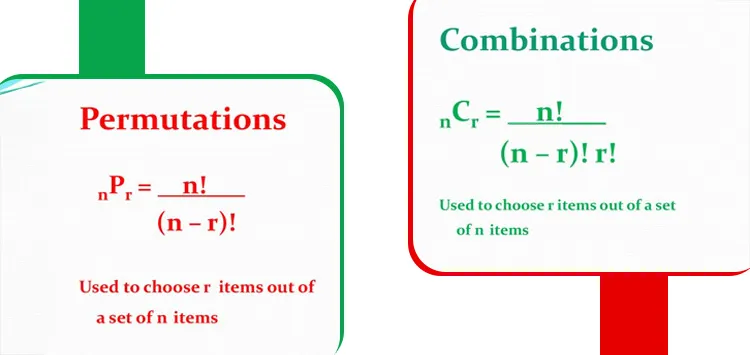


Difference Between Combination And Permutation
The Difference Between Combination and Permutation lies in the arrangement and selection of elements. In the realm of combinatorics, Combination and Permutation are distinct mathematical concepts that govern the ways elements can be chosen and ordered.
The arrangement of parts in a certain order is referred to as "permutation". It takes into account the order in which items are selected. For instance, arranging letters to form distinct words or organizing a set of numbers in a specific sequence involves permutations.
On the other hand, Combination focuses solely on the selection of elements without considering their order. It is concerned with forming groups from a set without regard to the arrangement of elements within the group. Choosing a committee from a pool of candidates or selecting a subset of items are examples of combinations.
The crux of Combination Vs Permutation lies in the consideration of order. Permutations involve the arrangement of elements in a particular order, while combinations focus solely on the selection of elements without concerning themselves with the order in which they are chosen.
Permutation Vs. Combination – The Basics
Permutation and combination are fundamental concepts in combinatorics, the branch of mathematics dealing with counting, arrangement, and selection of elements. Understanding the difference between permutation and combination is crucial in solving various problems.
The term "permutation" describes the placement of items in a certain sequence.
. The order in which items are arranged matters in permutations. For example, arranging the letters A, B, and C in different orders results in different permutations like ABC, BAC, and CAB.
On the other hand, combination involves selecting objects without considering the order. The order does not matter in combinations. For instance, choosing three colors from red, blue, and green is a combination, and the selection of red, blue, and green is considered the same as green, red, and blue.
The key difference between permutation and combination lies in the consideration of order. Permutations focus on the arrangement of elements, while combinations emphasize the selection without concern for the order. Both concepts play a vital role in solving problems related to probability, statistics, and various real-world scenarios.
Permutation: Definition, Example, And Formula
Permutation is a fundamental concept in combinatorics, representing the arrangement of objects in a specific order. In the realm of mathematics and statistics, permutations play a crucial role in various fields, from probability theory to cryptography. An Assignment Provider or Assignment Assistance service might encounter permutations when dealing with tasks related to coding, data analysis, or algorithm design.
The permutation formula is expressed as nPr, where "n" represents the total number of items and "r" denotes the number of items to be arranged. Mathematically, nPr = n! / (n - r)!, where "!" signifies the factorial, which is the sum of all positive integers up to a certain amount.
Consider a practical example: arranging a group of five students for a photograph. The number of ways to arrange them, say, in a row, is 5P5, which equals 120. This illustrates the versatility of permutations in calculating possibilities.
Understanding permutations is essential for solving complex problems and optimizing processes, making it a valuable tool for anyone seeking Assignment Assistance in mathematical or computational disciplines.
Understand The Basics Of Permutation Vs. Combination At BookMyEssay
Understanding the basics of permutation versus combination is crucial in various fields, and BookMyEssay provides comprehensive insights into this fundamental concept. The question, "How different are permutation and combination?" forms the cornerstone of this exploration. Permutation and combination are both mathematical concepts dealing with arrangements and selections, yet their distinctions are pivotal.
Permutation involves the arrangement of elements in a specific order, considering the order of selection. It answers questions like "In how many ways can a committee elect a president, vice president, and treasurer?" In contrast, combination ignores the sequence and instead focuses on the selection of pieces. "How many ways can a group of people be chosen for a committee?" is one example.
BookMyEssay delves into these intricacies, offering clarity through examples, exercises, and expert guidance. By grasping the nuances of permutation and combination, individuals can enhance their problem-solving skills and apply these principles across diverse disciplines, from probability in statistics to arrangements in computer science. BookMyEssay facilitates a solid foundation for understanding these mathematical concepts, paving the way for academic success and practical applications.
Popular Subject
- Cheap Homework Help
- Do My Essay Online
- London Assignment Writing Help
- Write My Assignment for Me
- A+ Certified Professional Assign...
- Yahoo! Query Language Assignment...
- Competition and Consumer Law Ass...
- Law Dissertation Assignment Help
- History Homework Writing Help
- Bamboo Flooring Assignment Help
- AP Style Writing Assignment Help
- Business Cycle Assignment Help
Rating

Charles
Australia
Rating:
Everything is good and helpdesk supports is cooperative, all problems of my assignment are solved perfectly.

Johnson
USA
Rating:
Thank you BookMyEssay for all your great services. I am so happy that I get this assistance with my study.

 3 Bellbridge Dr, Hoppers Crossing, Melbourne VIC 3029