Demonstrative Pronouns With Examples
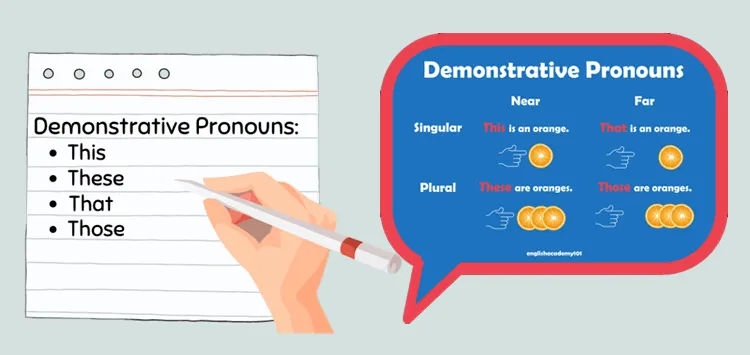
Demonstrative pronouns play a pivotal role in indicating specific objects or people in a sentence. With the guidance of assignment help tutors, mastering these pronouns becomes accessible. Demonstrative pronouns include "this," "that," "these," and "those." "This" and "these" refer to objects or people close to the speaker, while "that" and "those" denote objects or people farther away.
For instance, in the sentence, "This book is interesting," the pronoun "this" indicates the book close to the speaker. Conversely, in the sentence, "That movie was captivating," the pronoun "that" refers to a movie at a distance from the speaker.
Demonstrative pronouns not only specify but also streamline communication by eliminating redundancy. They replace nouns previously mentioned in the context, enhancing clarity and conciseness.
Understanding the nuances of demonstrative pronouns is essential in academic writing. Assignments benefit from precise language, and the correct usage of demonstrative pronouns ensures clarity and coherence. Moreover, when seeking assistance from assignment help tutors, students receive personalized guidance to grasp these grammatical concepts effectively.
By mastering demonstrative pronouns with examples, students can elevate their writing skills and enhance their ability to communicate ideas clearly and effectively. With the support of knowledgeable tutors, navigating the intricacies of grammar becomes more manageable, empowering students to excel in their academic pursuits.
Demonstrative Pronouns: What Are They?
Demonstrative pronouns are a crucial component of language, used to point out or indicate specific people, objects, or ideas in a sentence. In a demonstrative speech, understanding these pronouns is essential for effectively conveying information to the audience.
The four primary demonstrative pronouns in English are "this," "that," "these," and "those." They indicate proximity or distance in relation to the speaker and the listener. "This" and "these" refer to objects or people that are close, while "that" and "those" denote objects or people that are farther away.
For example, in a demonstrative speech about different types of flowers, the speaker might say, "This is a rose," while holding up a rose close to them, and "That is a daisy," while pointing to a daisy across the room. By using demonstrative pronouns, the speaker effectively directs the audience's attention to specific items and clarifies their relationship to each other.
Understanding demonstrative pronouns is vital for effective communication in both spoken and written language. In a demonstrative speech, these pronouns help the speaker organize their ideas and guide the audience's understanding of the topic. By mastering the usage of demonstrative pronouns, speakers can enhance the clarity and coherence of their speeches, ensuring that their message resonates with the audience.
What Distinguishes Demonstrative Pronouns From Other Pronoun Categories?
Demonstrative pronouns stand out from other pronoun categories due to their unique function in specifying or pointing out particular people, places, or things. Unlike personal pronouns, which replace specific nouns, demonstrative pronouns indicate specific items in the context of a sentence. This distinction is crucial in academic writing, where precision is paramount.
For example, consider the sentence, "This is my pen." Here, "this" serves as a demonstrative pronoun, pointing to the specific pen being referenced. Conversely, personal pronouns like "my" or "mine" would replace the noun "pen" without indicating which pen is meant.
Moreover, demonstrative pronouns distinguish themselves from possessive pronouns like "his" or "her" by emphasizing identification rather than ownership. While possessive pronouns denote possession or belonging, demonstrative pronouns focus on singling out or specifying a particular item.
Understanding these nuances is essential for students seeking coursework assistance or assignment help. Mastery of demonstrative pronouns ensures clarity and coherence in writing, preventing ambiguity and misunderstandings. Moreover, recognizing the distinctions between demonstrative pronouns and other pronoun categories enhances students' ability to construct grammatically correct and logically structured sentences.
With expert guidance from assignment help services, students can navigate the complexities of grammar more effectively, refining their writing skills and producing high-quality academic work. By grasping the unique role of demonstrative pronouns, students can elevate their writing to a more sophisticated level, effectively conveying their ideas with precision and clarity.
What Does The Usage Of Demonstrative Pronouns Mean?
The usage of demonstrative pronouns holds significant meaning in language, conveying specific information about the proximity of objects or people in relation to the speaker or writer. When students buy homework online, understanding demonstrative pronouns becomes crucial for effective communication and coherent writing.
Demonstrative pronouns, such as "this," "that," "these," and "those," serve to pinpoint and distinguish objects or people within a given context. "This" and "these" refer to objects or individuals that are nearby or within reach, while "that" and "those" denote objects or people that are farther away.
For instance, when someone says, "This book is fascinating," the demonstrative pronoun "this" indicates a book that is nearby or being held by the speaker. Conversely, if they say, "That painting is exquisite," the pronoun "that" points to a painting located at a distance from the speaker.
The usage of demonstrative pronouns adds precision and clarity to language, enabling speakers and writers to specify particular entities without the need for repetition or ambiguity. In academic writing, where clarity is paramount, mastering the usage of demonstrative pronouns is essential for effectively conveying ideas and arguments.
By comprehending the significance of demonstrative pronouns and their role in communication, students can elevate their writing skills and produce well-structured assignments. Seeking assistance from reputable sources like BookMyEssay ensures that students receive expert guidance in understanding and applying demonstrative pronouns effectively in their academic work.
Popular Subject
- Cheap Homework Help
- Do My Essay Online
- London Assignment Writing Help
- Write My Assignment for Me
- A+ Certified Professional Assign...
- Yahoo! Query Language Assignment...
- Competition and Consumer Law Ass...
- Law Dissertation Assignment Help
- History Homework Writing Help
- Bamboo Flooring Assignment Help
- AP Style Writing Assignment Help
- Business Cycle Assignment Help
Rating
4.9/5
5 Star Rating

Charles
Australia
Rating:
Everything is good and helpdesk supports is cooperative, all problems of my assignment are solved perfectly.

Johnson
USA
Rating:
Thank you BookMyEssay for all your great services. I am so happy that I get this assistance with my study.
3 Bellbridge Dr, Hoppers Crossing, Melbourne VIC 3029